
Allegany County Arrest Records and Charges
Allegany County arrest records begin on the law-enforcement and booking side. The public inmate portal research shows search result fields such as name, race, sex, birthdate, booked date, inmate number, and nickname. An inmate profile may show a mugshot, date of birth, age, inmate number, visit number, status, booking date and time, race code, sex, visitation schedule, bond section, charges section, case number, and charge text.
The court charge record is different. After an arrest or citation, the State's Attorney can review the matter and file, amend, reduce, dismiss, or decline charges. The inmate portal notice is explicit: arrest and booking information should not be relied on to determine the actual criminal record, may not reflect State's Attorney charging decisions or trial outcomes, and final disposition should be obtained from District Court. For the jail roster and custody side, use Allegany County inmate records. For the full case file and outcome, use Allegany County criminal court records.
The distinction also affects timing. A person can be booked before the court file fully reflects prosecutor review. A charge can appear in a jail profile before final disposition exists. A court case can later show a different count, a dismissal, or a plea outcome. The safest read is to treat booking as custody status, charge text as accusation data, and disposition as the court's formal outcome.
Search Allegany County Arrest Records
Use more than one access channel because no single record answers every question. The jail portal can show booking and custody information. Maryland Judiciary Case Search can show public District Court and Circuit Court case records. The Clerk of the Circuit Court and District Court can verify court-file information. The Sheriff's Office records and public access procedures apply when sheriff records are not published online.
- Search the Allegany County Detention Center portal for booking or custody detail when the person may be held locally.
- Search Maryland Judiciary Case Search by exact name or case number to locate public court charges after arrest.
- Read the charge list with current status, docket entries, plea, disposition, and sentence if available.
- Contact District Court or the Clerk of the Circuit Court when the online entry is unclear, restricted, or needs certification.
The Sheriff's Office standard operating procedures index is assigned to this page in the image manifest and confirms sheriff record categories such as warrant maintenance, prisoner transports, incident reporting, public access to records, and victim or witness assistance policies.
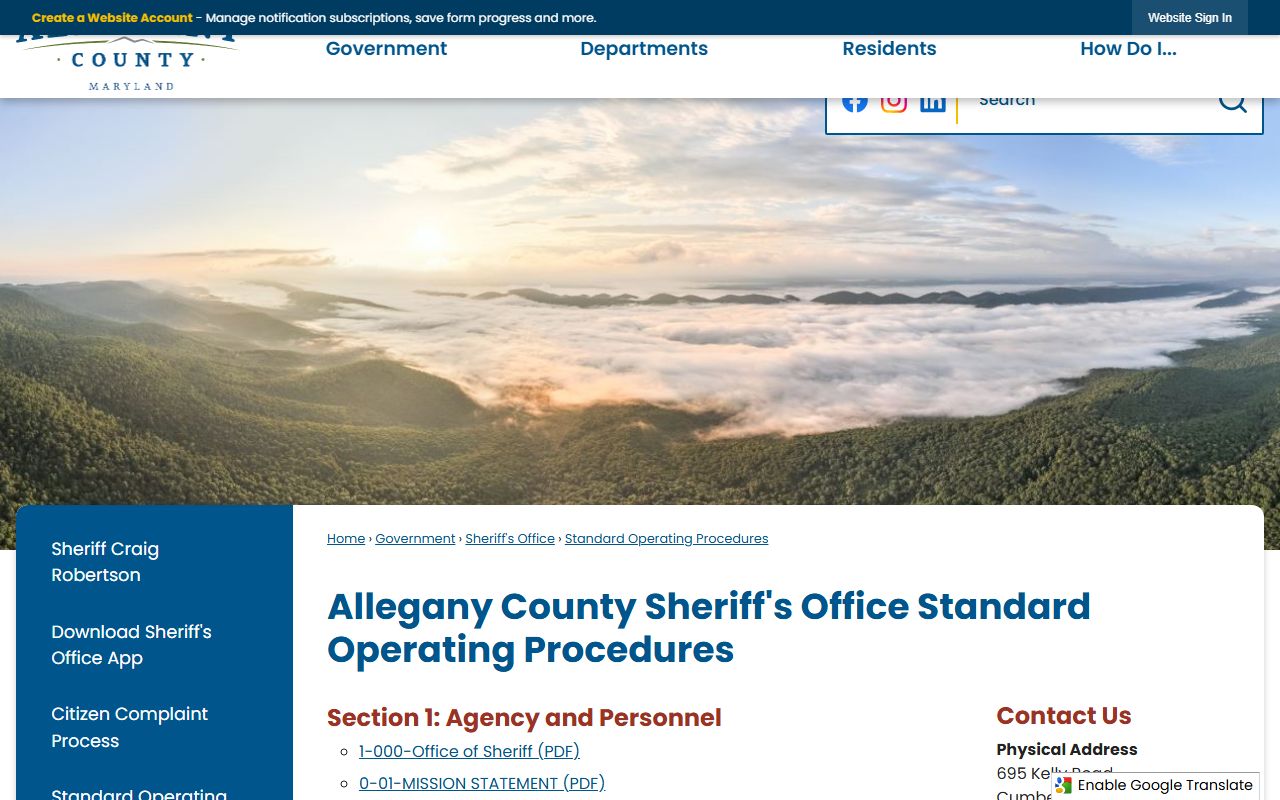
That sheriff source supports the law-enforcement side of the arrest-to-charges pathway without turning the court-charge page into a mugshot database.
Charges Filed After Arrest
A court charge record begins with a formal charging document. Maryland research for Allegany County identifies charging document, indictment, information, and citation as key terms. The State's Attorney role is to move a matter from arrest or investigation into prosecution when charges are pursued. One arrest can lead to no charge, one charge, several counts, amended counts, or a later violation of probation case.
| Document | Filed By | Common Use | What To Check |
|---|---|---|---|
| Complaint | Officer or prosecutor | Starts many criminal accusations in lower-court practice | Charge text, case number, and later disposition |
| Information | Prosecutor | Prosecutor-filed charging paper | Whether counts were added, amended, reduced, or dismissed |
| Indictment | Grand jury | Often used for serious criminal cases | Circuit Court case number, arraignment, plea, and sentence |
Allegany County Charge Status
Charge status is the bridge between arrest records and final criminal court records. A pending charge has not yet reached a final outcome. An amended or reduced charge means the filed accusation changed. A dismissed charge is not the same as a conviction. Nolle prosequi means the prosecutor declined to continue that charge. A violation of probation entry can arise after sentencing when supervision terms are alleged to have been violated.
| Status | What It Means | Why It Matters |
|---|---|---|
| Pending | The charge is still active in court. | Do not treat it as a final outcome. |
| Amended / Reduced | The original charge changed to another count or severity. | Read the latest charge and disposition together. |
| Dismissed | The court ended the count or case without conviction on that charge. | Eligibility for expungement may depend on the exact outcome. |
| Nolle Prosequi | The prosecutor chose not to pursue the charge. | The docket should still be checked for related counts or later filings. |
| Violation of Probation | The case concerns alleged noncompliance with probation terms. | It may connect to an older criminal case and a new warrant or hearing. |
Court Charges vs Convictions
Charges after arrest are accusations. Convictions are outcomes. Allegany County arrest records and charge records can contain serious-looking entries that later end in dismissal, acquittal, nolle prosequi, probation before judgment in eligible circumstances, or a different plea result. The safest reading method is to move from booking, to filed charges, to docket entries, to final disposition.
| Charge | Conviction | |
|---|---|---|
| Meaning | A filed accusation after arrest, citation, or prosecutor review | A final court result based on plea, verdict, or qualifying judgment |
| Where Seen | Booking profile, charging document, Case Search, court docket | Disposition and sentence lines in the criminal court record |
| Risk | May be amended, reduced, dismissed, or not prosecuted | May affect sentence, probation, fines, records, and driver or custody consequences |
Note: The booking notice itself warns that final disposition should come from District Court or the court file.
Who Files Allegany County Charges
The Allegany County State's Attorney is James F. Elliott. The State's Attorney Office main office and Circuit Court Division are listed at 59 Prospect Square, Suite 111, Cumberland, with phone 301-777-5962 and hours of Monday through Friday, 8:00 AM to 4:00 PM. The District Court Division is listed at 123 Liberty Street, Cumberland, with phone 301-777-5577. That split matters because District Court and Circuit Court criminal matters may be routed through different local divisions.
The research describes Elliott as having served as Assistant Public Defender for Allegany and Garrett counties and as district public defender from 2017 to 2021 before becoming State's Attorney. That background is not a record-search shortcut, but it helps identify the official local prosecuting office rather than using the wrong title. Maryland uses State's Attorney, not District Attorney.
Law enforcement creates the arrest or booking path. Prosecutors decide what charges to pursue in court. The court then records hearings, pleas, motions, dispositions, and sentencing. A person seeking legal help should use the Maryland Office of the Public Defender if eligible or contact counsel. A person seeking records should use the relevant agency or court record channel, not a private background search as a substitute for court verification.
State's Attorney Office
59 Prospect Square, Suite 111
Cumberland, MD 21502
301-777-5962
Monday-Friday, 8:00 AM-4:00 PM
Allegany County Sheriff's Office
695 Kelly Road
Cumberland, MD 21502
301-777-1585
Emergency: 911
Restricted Arrest and Charge Records
Public access is limited by Maryland judicial-record rules, juvenile confidentiality, expungement laws, sealing orders, and redaction rules. Juvenile matters and adoption records are not ordinary public case files. Expunged records should not appear in ordinary public access. Social Security numbers, financial account data, protected addresses, minor names, medical or mental-health details, and other identifiers should be withheld or redacted in public copies.
| Sealed | Expunged | |
|---|---|---|
| Public Access | Hidden by court order, rule, statute, or confidentiality category | Removed from public access after the court grants eligible relief |
| Common Trigger | Sensitive facts, juvenile status, protected party data, or court action | Eligible dismissals, acquittals, nolle prosequi entries, and other qualifying outcomes |
| Practical Step | Ask the court that holds the file about access or required orders | Use the exact case number and disposition when filing the petition |
Two remaining manifest images assigned to this page come from probate sources: the Allegany Register of Wills page and the Register of Wills Estate Search.
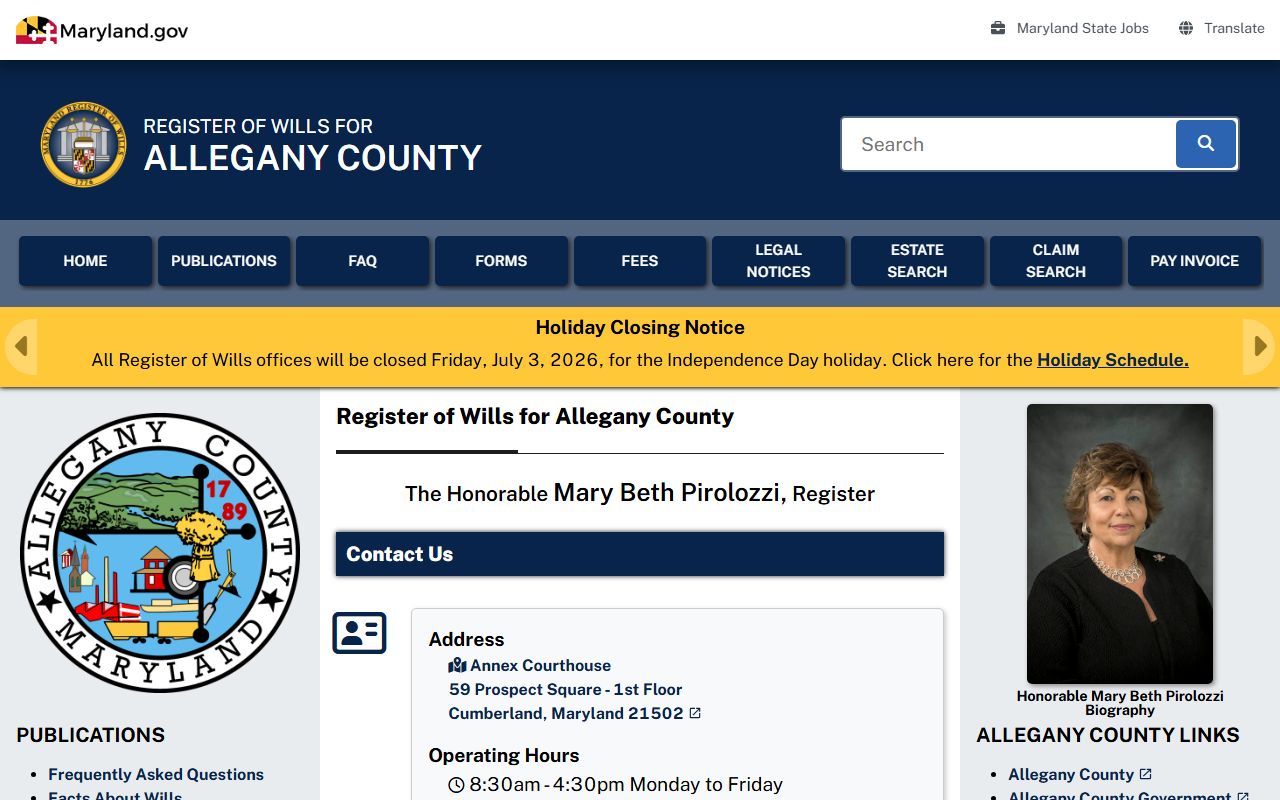
Those sources are not arrest databases, but they illustrate why Allegany County record searches must be routed by record type instead of assuming every public record is a criminal charge record.
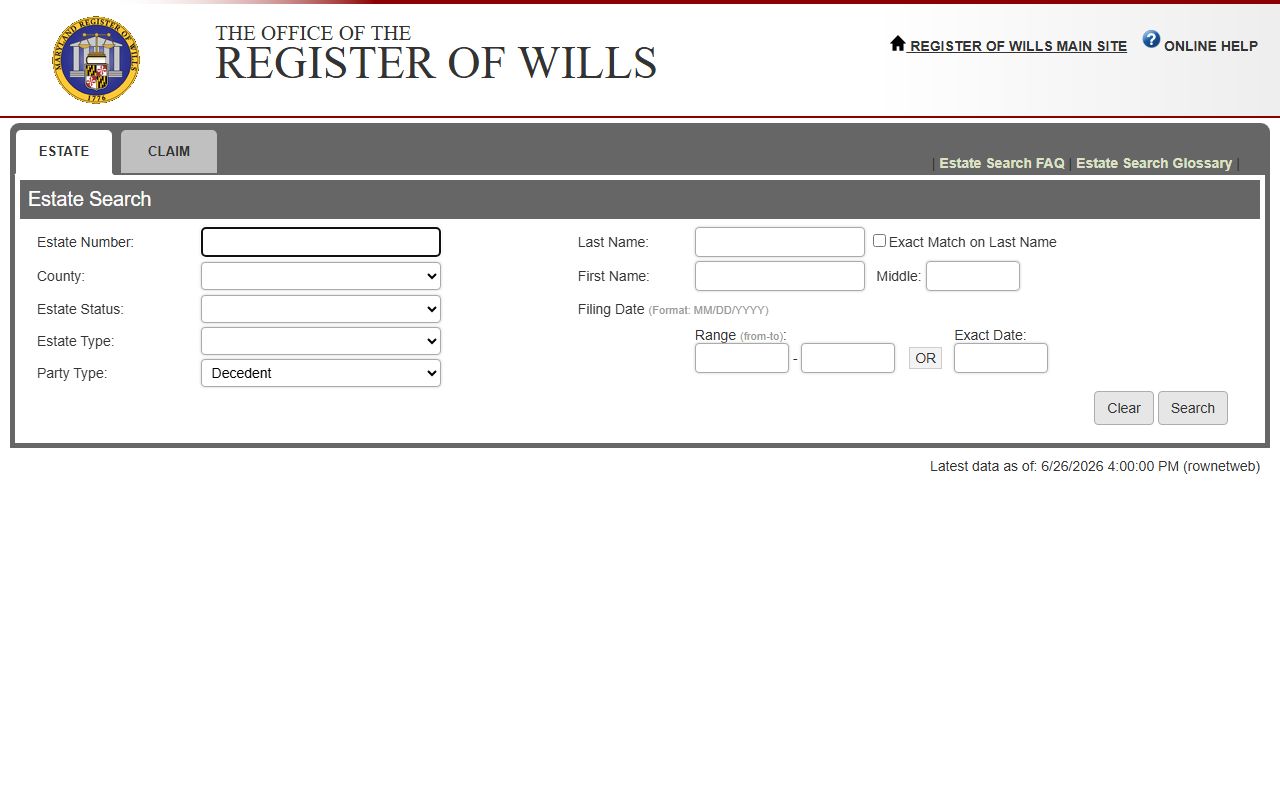
The estate-search example reinforces the same routing rule: probate records, booking data, and charges after arrest live in different official systems.
Use Arrest Records Carefully
Arrest records and court charges can be useful for personal case tracking, court-date checks, and understanding why a person was booked or charged. They are not consumer background reports. A public charge record can be incomplete without the final disposition, and a public booking entry may lag behind prosecutor decisions or court outcomes. When accuracy matters, verify the case number, court, current charge status, and disposition with District Court, the Clerk of the Circuit Court, or the official case record.
Maryland Public Information Act procedures may apply to sheriff or executive-branch records that are not published online, while judicial-record access rules apply to court files. That division matters for Allegany County arrest records because an incident report, jail booking profile, charging document, and final court disposition can be held by different offices. Ask the agency that created or maintains the record rather than assuming one counter can release every part of the arrest-to-charges file.
Important: Do not use casual arrest or charge lookups for FCRA employment, tenant, credit, or insurance decisions.